The ocean around Puerto Vallarta is warm, the waves on the beginner beaches are small and the vast majority of surf days end with nothing worse than tired shoulders and a sunburnt nose. But every year we meet visitors who got caught in a current, stepped on a stingray or spent a holiday day in bed with sunstroke — things that are almost always avoidable when you know what to look for.
Before every lesson we spend ten minutes on the sand reading the ocean with our students. This article is the long version of that briefing. Read it before your trip, whether you surf with us, rent a board or just want to swim safely.
1. Rip currents: the number one hazard
Waves push water onto the beach, and that water has to go back out to sea. It does so through channels — rip currents, or corrientes de resaca in Spanish. They are present on almost every beach with waves, they are strongest when the surf is bigger and they can carry a swimmer away from shore faster than they can swim against them.
How to spot a rip current
- A calm-looking gap in the line of breaking waves — fewer waves break there because the water is deeper and moving outwards.
- Darker water than on either side, because the channel is deeper.
- Foam, seaweed or sand-coloured water moving away from the beach.
- A rippled, choppy surface in an otherwise organised line-up.
The cruel trick of rips is that the calm gap looks like the safest place to swim. It is not. Surfers sometimes use rips on purpose to paddle out easily — that is an advanced skill for people who know exactly where the current ends. Beginners should stay well away from them.
How to get out of a rip
- Do not fight it. Paddling or swimming straight against a rip is how people get exhausted.
- Stay on your board. A surfboard floats; as long as you are on it, you are safe. Never let go of it to swim.
- Paddle parallel to the beach until you feel the current release you — rips are usually narrow.
- Come back in with the whitewater where the waves are breaking, which pushes you towards the beach.
- Without a board: float on your back, keep calm, raise an arm and wave for help, and swim parallel to the shore when you can.
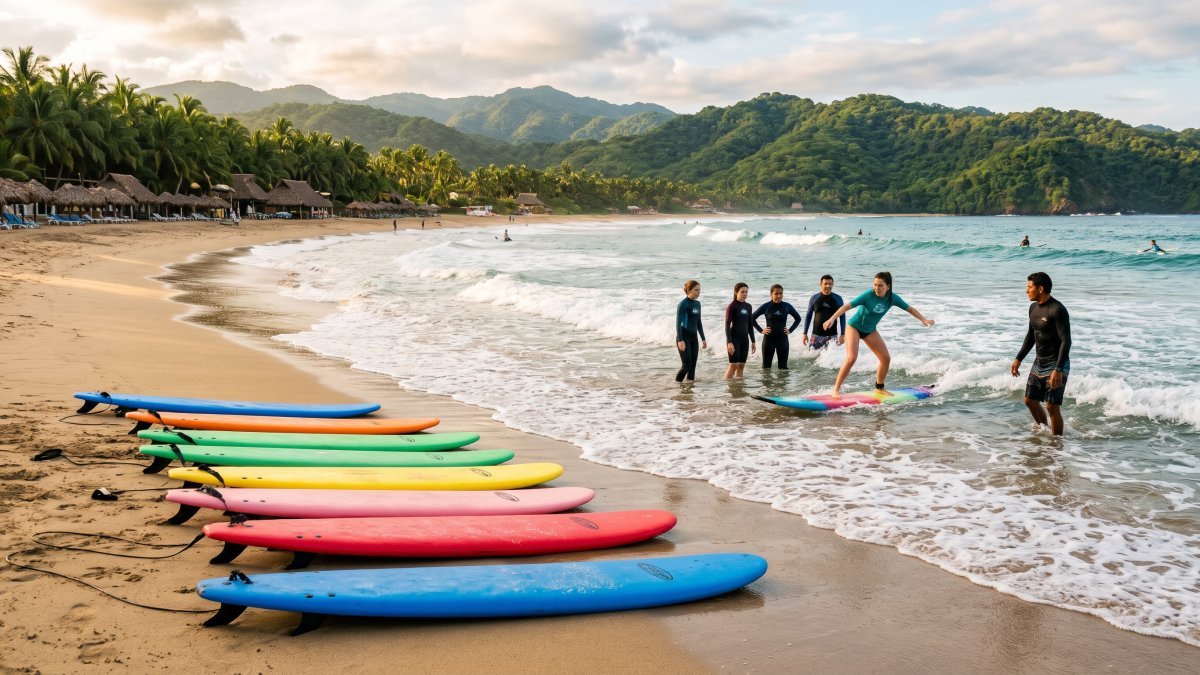
In our lessons beginners surf in waist-deep water, inside the area where the waves have already broken, with a coach next to them. That alone removes most of the risk — but it is good to know the rule for when you surf on your own later.
2. Stingrays and the "stingray shuffle"
Stingrays (rayas) like to rest half-buried in the warm sand of shallow water, and Banderas Bay has its share, especially in the warmer months. They are not aggressive; they sting when someone steps right on top of them. The solution is simple and takes no effort: shuffle your feet when you walk in shallow water instead of taking big steps. The vibration warns them and they glide away.
If you get stung
- Get out of the water and rinse the wound with clean water.
- Soak the area in water as hot as you can tolerate without burning yourself — heat breaks down the venom and relieves the pain, usually within 30 to 90 minutes.
- See a doctor or a clinic: the wound should be cleaned properly and checked for pieces of the barb.
It hurts — a lot — but it is rarely dangerous for a healthy adult. Every local surfer has a story about it; shuffle your feet and you will not have one.
3. Sea urchins and sharp reef
Some of the best waves in Riviera Nayarit break over reef and rock, not sand. Reef breaks give longer, more predictable waves — which is why we use them as students progress — but the bottom can hold sea urchins (erizos) and sharp rock.
- Fall flat, not deep. When you wipe out over a reef, fall like a starfish on the surface of the water instead of diving or jumping feet-first.
- Do not stand up on the reef. Paddle out and back in over deeper water; your coach will show you the channel.
- Consider booties on rocky spots. On sandy beaches like Nuevo Vallarta you will not need them.
- If you step on an urchin, do not dig the spines out with a needle. Soak in hot water, remove only the spines sticking out, and see a doctor if the area gets red, swollen or the spines are deep.
This is also why levels matter. Beginners belong on sandy beach breaks and soft inside sections; reef peaks come later. Our surf spots guide lists the level of every break, and on lesson days the coach chooses the spot that is safe for you that morning.
4. Jellyfish and other sea life
Jellyfish show up occasionally in the bay, usually for a few days at a time when currents and water temperature bring them in. Most stings are a mild burning rash. Rinse with seawater (not fresh water), remove any tentacles with something other than your bare fingers, and apply vinegar if you have it. Get medical help for strong reactions, difficulty breathing or stings on large areas of skin. A rash guard covers a lot of your body and helps here too.
You will also hear about crocodiles in Puerto Vallarta. They live in estuaries, lagoons and some river mouths around the bay — not in the surf line. Respect the warning signs, stay away from estuary water and you will see them, if at all, from a safe distance.
5. The sun: the hazard everybody underestimates
Puerto Vallarta sits at about 20 degrees north. The sun is strong all year and the UV index is often extreme even when it is cloudy. On the water the reflection doubles the dose. More holiday days are lost to sunburn and heat exhaustion than to anything that lives in the sea.
- Wear a rash guard. It is included in every lesson and protects your back and shoulders far better than any cream.
- Sunscreen 20 minutes before going in and again at every break. Reef-safe formulas protect the coral and the fish you snorkel with later.
- Do not forget the backs of your knees, your ears, the top of your feet and the back of your neck — the classic beginner burns, because you spend so much time lying on the board.
- Drink water before, during and after. Thirst arrives late.
- Surf early. Mornings have smoother water and gentler sun. That is why our lessons start early.
6. Your board is the other hazard
A surfboard is a big, fast object attached to your ankle. Most surf injuries come from boards, not from the ocean.
- Never put the board between you and a wave. Keep it to your side when walking out; a wave can push it straight into you.
- Cover your head with your arms when you fall and when you come up, until you know where your board is.
- Fall away from the board, behind or to the side, never in front of it.
- Always wear your leash on your back ankle so the board stays near you and does not hit someone else.
- Learn on a soft-top. Our beginners use big soft boards, which are far more forgiving if they bump you.
7. Other surfers and line-up etiquette
Etiquette is a safety system. Collisions happen when two people ride the same wave or someone paddles straight into the path of a surfer who is riding. The surfer closest to the breaking part of the wave has priority; do not "drop in" in front of them. When you paddle back out, go around the line-up through the whitewater, not through the middle of where people are riding. And look before you go — every time. If you want the vocabulary to understand what people shout at you, our Spanish surf slang guide will help.
8. Season and weather: summer storms and big swells
From November to April the swells are smaller and more consistent — the best time to learn. From May to October the bay gets bigger, more powerful south swells, warmer water and the rainy season. Two things matter in summer:
- Thunderstorms. Afternoon and evening storms are common in the rainy season. If you hear thunder or see lightning, get out of the water — a surfer is the tallest thing on a flat ocean.
- Swell from tropical storms. Hurricane season can send big, irregular waves to the coast. On those days beginner beaches may close out; surf only with someone who knows the conditions.
Our month-by-month guide to surfing in Puerto Vallarta covers what to expect in every season.
9. River mouths after heavy rain
After heavy rain, rivers and storm drains carry runoff into the sea. River mouths can have murky water, floating debris and higher bacteria levels for a day or two. As a rule of thumb, wait 24 to 48 hours after a big storm before surfing close to river mouths, and avoid getting water in your mouth. If you have open cuts, cover them.
10. Know your limits — and pick the right teacher
The most dangerous wave is the one that is too big for you. Surf where your level fits: whitewater and sandy beach breaks first, then unbroken waves, then reef peaks, then bigger days. Ask locals and surf schools about conditions, never surf alone in an unfamiliar spot, and when in doubt, do not paddle out.
If you are learning, choose a school that teaches safety, not just pop-ups. With us that means:
- Lifeguard-trained coaches and a maximum of three students per instructor.
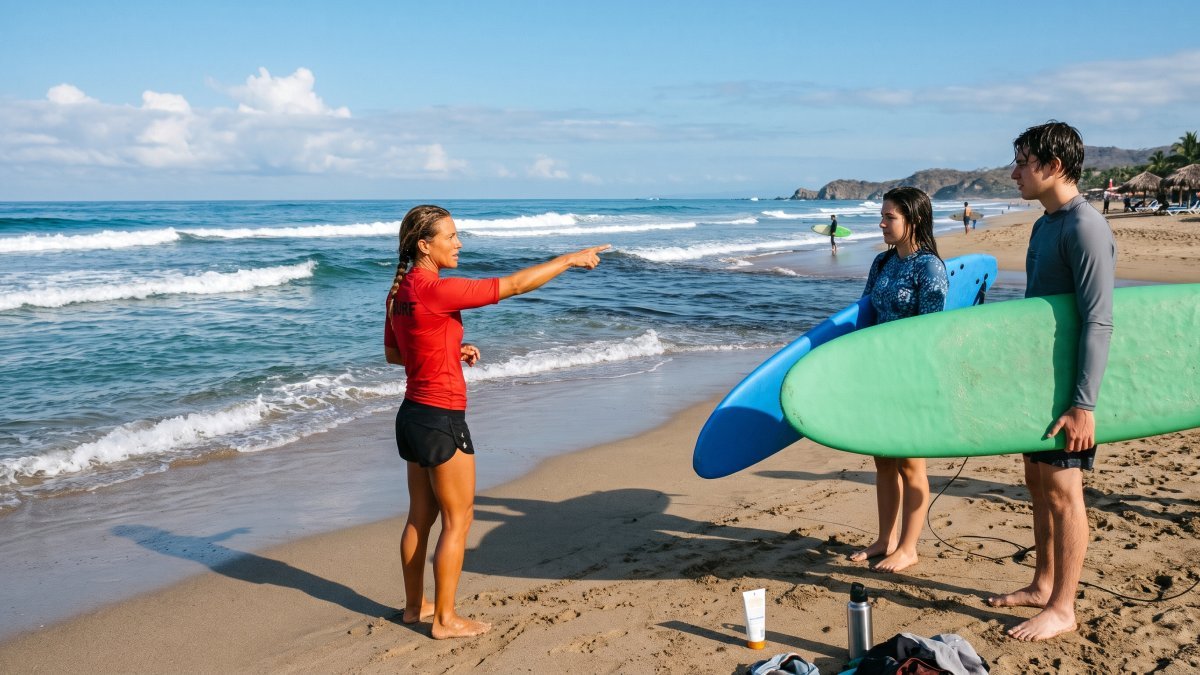
- A safety and ocean-reading briefing on the sand before every lesson.
- Big soft-top boards, leashes and rash guards included.
- The spot chosen every morning according to swell, wind and tide — we take you where the conditions are right for your level that day.
Prices and formats are on our surf lessons page: Join Group from $90 USD per person and Private Group $100 USD per person (both with a minimum of 2 persons), personalized 1-on-1 $110 USD. If it is your first time, read what to expect in your first surf lesson next.
Emergency information
- Emergency number in Mexico: 911 (police, ambulance, fire).
- Puerto Vallarta, Nuevo Vallarta and Bucerías have hospitals and clinics; keep your travel insurance details on your phone.
- Save your hotel's address and your surf school's WhatsApp before you go to the beach.
- If someone is in trouble in the water, call for help first and throw something that floats — a board is perfect — before you think about swimming out yourself.
Frequently asked questions
Is it safe to surf in Puerto Vallarta?
Yes, with common sense and the right beach for your level. The main hazards — rip currents, stingrays, urchins on reef breaks and strong sun — are all manageable once you know them.
How do I escape a rip current?
Do not fight it. Stay on your board, breathe and paddle parallel to the beach until you are out of the current, then come back with the whitewater. Without a board, float, wave for help and swim parallel to shore.
Are there stingrays in Puerto Vallarta?
Yes, on some sandy bottoms. Shuffle your feet in shallow water. If you are stung, soak the area in water as hot as you can tolerate and see a doctor.
Do I need reef booties?
Not on sandy beach breaks. On reef breaks they help against urchins and rock; your coach will tell you if they make sense that day.
Do I need a wetsuit?
No. The water is around 22–26 °C in winter and warmer in summer. A rash guard is enough; some surfers add a thin top in February and March.
What is the emergency number in Mexico?
911, from any phone.