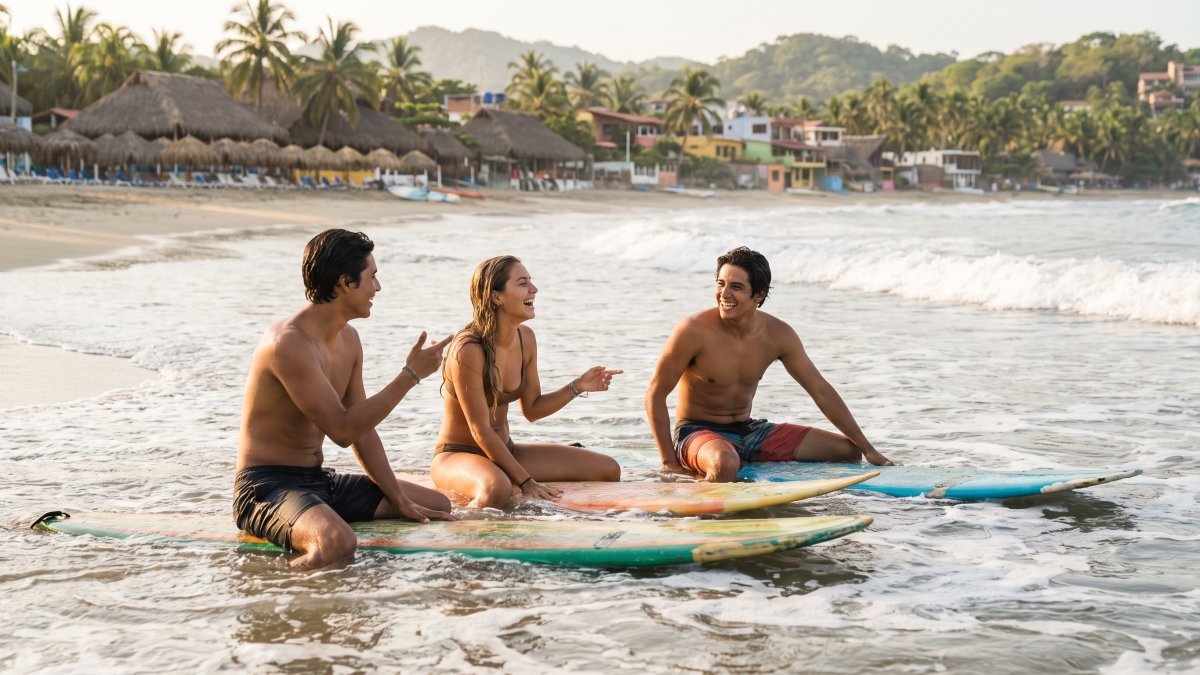
Every line-up in the world runs on a handful of shouted words. They tell you who has the wave, when to duck, when a set is coming and whether the morning is worth the alarm. In Puerto Vallarta, Sayulita, La Lancha and Punta de Mita those words are Spanish — Mexican Spanish, with a coastal accent and a sense of humour — and learning them does two things. It makes you safer, because you understand the warnings. And it makes you welcome, because nothing opens up a beach faster than a visitor who says buenos días and knows what la serie means.
We have grouped them the way you will meet them: the ocean, the board, the calls, the etiquette, the conditions report and the after-surf. Pronunciation notes where it matters. No exam at the end, but Emilian may test you at La Lancha.
Part 1 — The ocean: waves, sets and what they do to you
- La ola — the wave. Olas, plural. "¿Cómo están las olas?" is the first question of every morning and, honestly, of every WhatsApp group.
- La serie — the set: a group of larger waves arriving together. "¡Viene serie!" (set coming!) is the call that makes everyone sit up and paddle for the horizon. Also el set, borrowed straight from English.
- El pico — the peak, the spot where the wave first breaks and where the surfers with priority sit. "Siéntate más adentro del pico" — sit deeper on the peak.
- La espuma — the foam, the whitewater. Beginner waves are espuma; your first lesson is spent riding it. Not an insult — every surfer in the water started there.
- El tubo — the barrel, the hollow part of a breaking wave. Rare on our beginner beaches, common in the stories told afterwards.
- La pared — the face or "wall" of the wave, where you actually ride. "Tiene buena pared" means the wave is long and open.
- Cerrarse / se cierra — to close out: the whole wave breaking at once with no wall to ride. "Esa se cierra" — skip that one.
- El revolcón — a wipeout, from revolcar, to tumble. What the wave does to you when it wins. Also, more vividly, la lavadora — "the washing machine". Yelled with joy at whoever just went through the spin cycle.
- Mar de fondo — ground swell: long-period waves from a distant storm, the kind that make good surf. When the forecast says mar de fondo del sur in summer, the whole coast lights up (see our month-by-month swell guide).
- La corriente — the current, including the rip. "Hay corriente hacia la punta" — there is a current pulling toward the point. Listen when a local says it.
- La marea — the tide. Marea alta (high), marea baja (low), subiendo (rising), bajando (dropping). La Lancha is best on a rising mid tide; Sayulita changes character completely between the two.
Part 2 — The board and the body
- La tabla — the surfboard. Not el tablero (that is a chessboard or dashboard — a common and much-enjoyed mistake).
- El espumero — a soft-top, beginner foam board, from espuma. What you will learn on, and what half the line-up at Nuevo Vallarta is riding on any given morning. Say it proudly.
- El longboard / el shortboard — borrowed as-is. Also tablón for a big longboard, affectionately.
- La quilla — the fin. Quillas, plural. Pronounced KEE-ya. You will meet this word the first time one goes missing in the sand.
- El invento / la correa / el leash — the leash. All three are used; invento ("the invention") is the old-school one.
- La cera / la parafina — wax. "¿Me prestas cera?" — can I borrow some wax? — is the most reliable way to start a friendship on any beach in Mexico.
- La licra — the rash guard (from lycra). Included in every Vallarta Surf lesson; also the word for a lot of other stretchy things, so context matters.
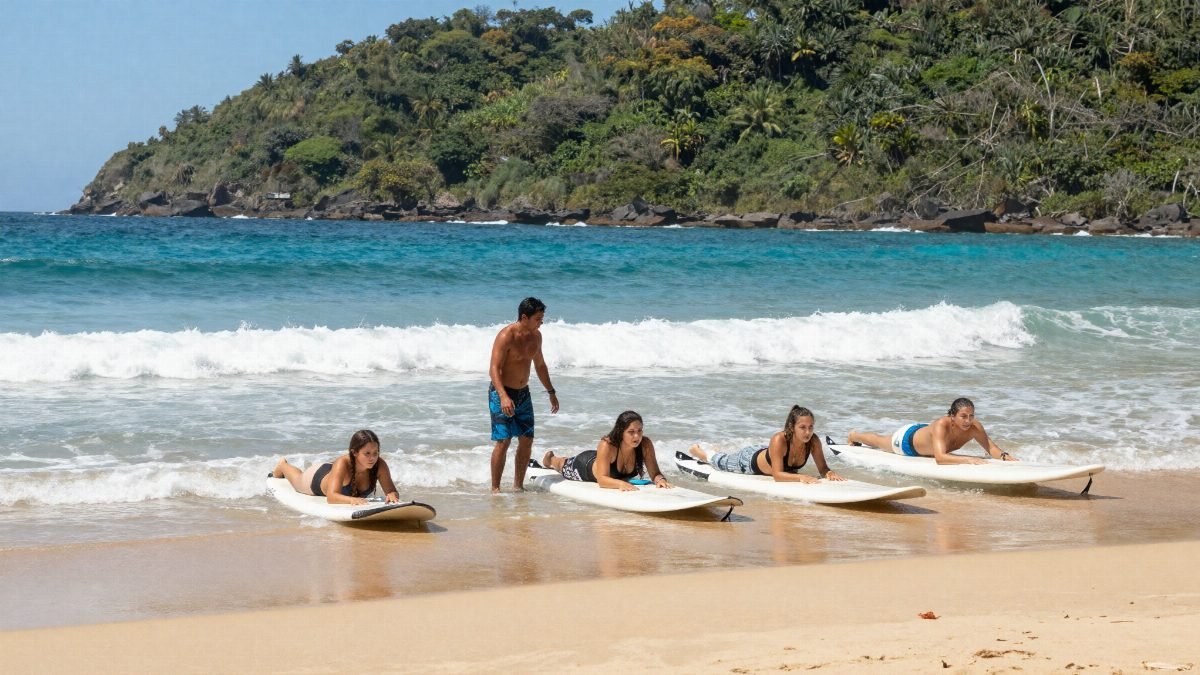
- Remar / la remada — to paddle / the paddle. "¡Rema, rema, rema!" is the sound of every surf lesson on the planet, in every language.
- Pararse — to stand up. "¡Te paraste!" — you stood up! — followed by cheering from the instructor, is the goal of day one.
- Regular / goofy — your stance, borrowed unchanged. Left foot forward is regular; right foot forward is goofy. Nobody knows why either, in any language.
- El pato / hacer el pato — the duck dive, from pato, duck. Pushing the board under a breaking wave. Not possible on an espumero, which is why beginners learn the turtle roll first — la tortuga.
Part 3 — The calls that keep everyone safe
These are the ones to learn even if you learn nothing else. They are shouted, they are short, and they are about not hurting each other.
- ¡Aguas! — "Watch out!" Literally "waters!", from the days when people emptied buckets out of windows. In the line-up it means: a board is loose, a set is coming, someone is about to land on you. Protect your head.
- ¡Voy! / ¡Mía! — "I'm going!" / "Mine!" The surfer closest to the peak is claiming the wave. If you hear it, pull back. Saying it yourself, early and clearly, prevents nearly every collision.
- ¡Es tuya! / ¡Dale! — "It's yours!" / "Go for it!" The most generous words in surfing. Somebody with priority is giving you the wave. Say gracias — after you ride it.
- ¡Adentro! — "Outside!" (literally "inside", meaning further into the sea). A bigger set is coming — paddle out, now.
- ¡Cuidado con las rocas! — "Careful with the rocks!" Relevant at the point breaks around Punta de Mita and Burros, less so at the sandy beginner beaches.
- ¡Suelta la tabla! — "Let go of the board!" What an instructor yells when a wave is about to drive your board into your face. Counter-intuitive, correct.
- ¿Estás bien? — "Are you OK?" What everybody asks after a big lavadora. The right answer, always, is a thumbs-up and a grin.
Part 4 — Etiquette: the phrases that make you welcome
Mexican beach culture is polite before it is anything else, and the line-up is no exception. The rules are the same as everywhere — priority to the surfer nearest the peak, no dropping in, no paddling through the middle of the take-off zone — but the way they are enforced here is with words and smiles, not with fists. A few phrases carry a lot of weight:
- Buenos días — say it to the people already sitting in the water when you paddle out. It is the single most effective piece of surf etiquette in Mexico, and the one visitors most often skip.
- Con permiso — "with your permission", said when you paddle past or close to someone. Costs nothing, earns a lot.
- Perdón / disculpa — sorry. You dropped in on someone by accident (it happens). Say it immediately and loudly, and it is over. Do not say it and you will hear the next word.
- Localismo — localism. Almost non-existent on the beginner beaches of Banderas Bay, and rare even in Sayulita. It shows up only when visitors take every wave, snake the peak or ignore the greeting. Read more in our note on surf culture and community in Puerto Vallarta.
- ¡Buena! — "Nice one!" — shouted when someone gets a good ride. Say it to strangers. It is the fastest way into a line-up's good graces, and it is free.
- ¡Órale! — the all-purpose Mexican exclamation: wow, go on, right on, no way. Someone drops into a wave that looked too big and rides it out — ¡órale!. Cannot be overused.
- Compa / carnal / wey — mate, bro, dude. Compa is safe and friendly for everyone. Wey (also güey) is extremely common between friends and slightly rude from a stranger — listen for a week before you use it.
Part 5 — The conditions report
This is the vocabulary of the 6 a.m. WhatsApp message, the taxi conversation and the phone call to the surf school. Master it and you can hold your own with any fisherman on the Malecón.
- Está planchado — "it's ironed": glassy, no wind, perfect. The word every dawn patroller wants to hear (our hour-by-hour dawn patrol guide explains why mornings are planchado and afternoons are not).
- Está picado — choppy, from picar, to chop. Onshore wind has arrived. Time for tacos.
- Está chiquito / está grande — it's small / it's big. Relative to the speaker, always. A local's chiquito may be a beginner's grande.
- Está plano / no hay nada — it's flat / there's nothing. Read our guide to what to do on a flat day in Puerto Vallarta.
- Terral — the offshore land breeze of the early morning. Brisa — the onshore sea breeze that arrives late morning. One is your friend; the other sends you to breakfast.
- Mar de fondo del sur / del noroeste — south swell (summer, powerful, for experienced surfers) / north-west swell (winter, gentle, for beginners). The two seasons of Banderas Bay in six words.
- Reventando afuera — "breaking outside": the swell is big enough that the outer sandbars are working. At La Lancha this is the signal for intermediates and the cue for beginners to stay on the inside.
- Hay gente / está solo — it's crowded / it's empty. The second one is the reason the dawn patrol exists.
Part 6 — The after-surf
- La palapa — the thatched-roof beach restaurant where every session ends. Sand floor, plastic chairs, best fish in Mexico.
- Tacos de pescado / de camarón — fish tacos / shrimp tacos. The post-surf meal on this entire coast; we ranked the best places in our guide to seafood in Puerto Vallarta.
- Aguachile — raw shrimp cured in lime, chile and cucumber. Nayarit's gift to the world and the reason you will not want to leave.
- Una michelada — beer with lime, salt and sauces. Debate is ongoing about whether it counts as breakfast. On the coast, after a dawn patrol, it does.
- Agua de coco — coconut water, straight from the coconut, sold on the beach by someone with a machete. The best rehydration there is.
- ¿Mañana a qué hora? — "What time tomorrow?" The sentence that ends every good session and starts the next one.
Five words that do not translate (and why we love them)
Lavadora — the washing machine — is funnier than "wipeout" because it describes exactly how it feels. Aguas makes no sense as a warning and every Mexican understands it instantly. Planchado says "glassy" in a way that includes the whole quiet, shiny stillness of a 7 a.m. bay. Órale covers every emotion from surprise to encouragement and saves you learning fifty other words. And compa — short for compadre, the godparent of your child — turns a stranger in the line-up into somebody you are, in a small way, responsible for. Which, in the water, you are.
A ten-word survival kit
If you only remember ten before your first lesson, make it these: buenos días · ola · serie · ¡voy! · ¡es tuya! · ¡aguas! · remar · pararse · planchado · gracias. Everything else you will pick up the way we did — by hearing it shouted at you with a laugh, somewhere between the peak and the beach.
Frequently asked questions
Do I need to speak Spanish to take a surf lesson in Puerto Vallarta?
No. Vallarta Surf lessons are taught in English (or Spanish, if you prefer). Knowing a dozen line-up words simply makes the beach friendlier and safer, and locals notice the effort.
What does "¡es tuya!" mean?
"It's yours!" — the surfer with priority is giving you the wave. Go, then say gracias. The opposite call, "¡voy!" or "¡mía!", means the other surfer is taking it.
What is "está planchado"?
"It's ironed": glassy, windless, smooth. The best possible conditions report. "Está picado" (choppy) is the opposite.
What does "¡aguas!" mean?
"Watch out!" A very Mexican warning with no connection to water despite the word. Duck, cover your head, or paddle.
Is there localism in Puerto Vallarta and Sayulita?
Very little, especially at the beginner beaches. Greet people, wait your turn, do not drop in, and you will be welcome.