Every surf town has its season. In Riviera Nayarit we have two that overlap: the winter surf season, when the north-west swells clean up the beginner beaches and the mornings go glassy, and the whale season, when Banderas Bay becomes one of the busiest humpback nurseries on the Pacific coast of Mexico. They run at the same time, on the same stretch of coast, and if you time a trip right you get both from the same beach on the same morning.
When the whales arrive: the 2026–2027 calendar
Humpbacks feed all summer in the cold water off Alaska, British Columbia and California, and migrate south to breed and give birth in warm, protected water. Banderas Bay — deep, wide, sheltered by Cabo Corrientes to the south and Punta de Mita to the north — is exactly that. Here is how the season normally unfolds, and what it means for surfers:
- Late November 2026: the first blows off Punta de Mita and the Marietas. The north-west swells have already started; La Lancha is working.
- December 2026: the official season opens (the environmental authority sets the dates each year under the whale-watching standard NOM-131 — normally the second week of December). Sightings become daily. Holiday crowds arrive; book lessons early.
- January 2027: peak numbers. Breaching, tail slaps, the "heat runs" of males chasing a female. Cool, clean, offshore mornings — the best month of the year to learn.
- February 2027: mothers with calves close to shore, sometimes inside the bay off Nuevo Vallarta and Bucerías. Flattest sea, warmest days, still consistent small swell.
- March 2027: whales thin out, the season closes around the third week, and the last of the north-west swell overlaps with the first south swells. Quiet line-ups.
- April 2027: a straggler or two, then they are gone until November.
Which surf spots put you closest to the whales
Not every break has a view of the bay's mouth, and that is where most of the action is. From our map of surf spots in Puerto Vallarta and Riviera Nayarit, these are the ones where you will see whales from the water:
La Lancha — the front-row seat
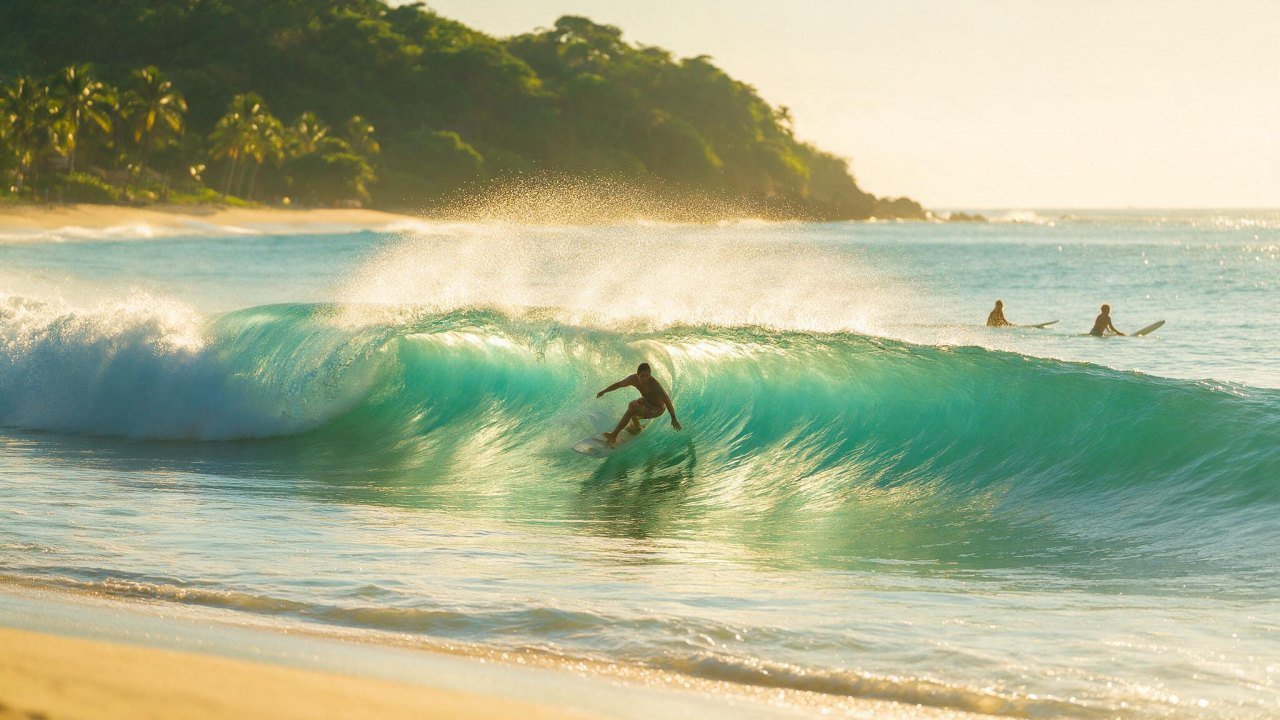
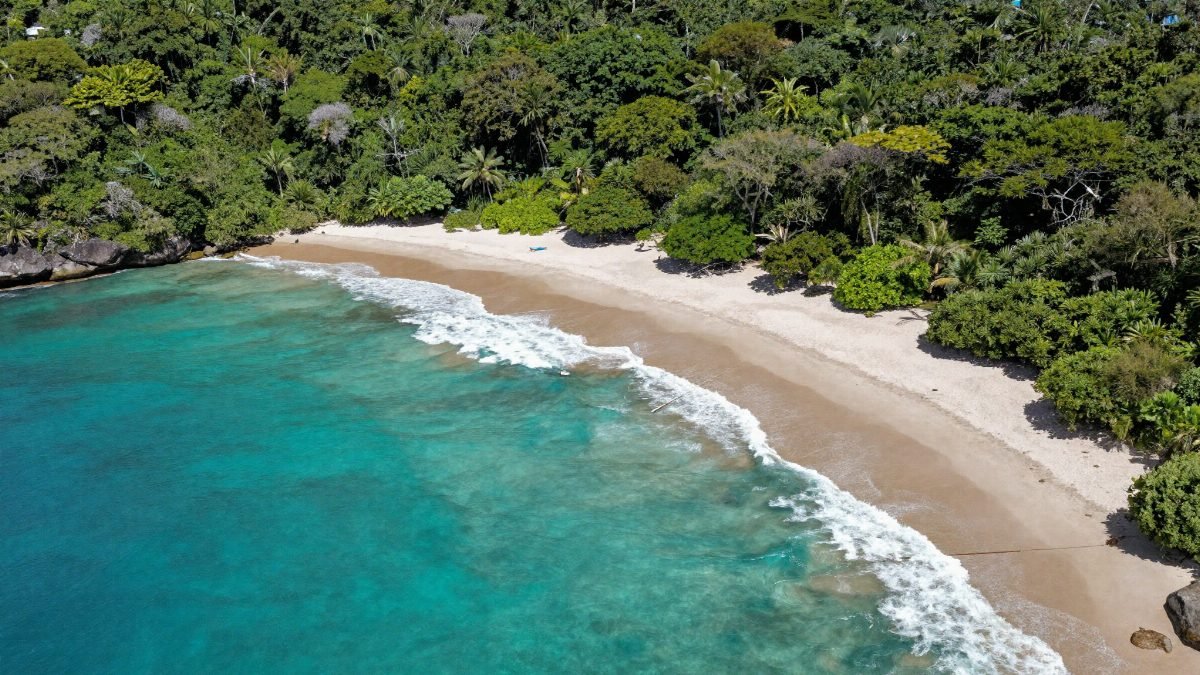
La Lancha faces west, straight out over the entrance of the bay toward the Marietas. On a January morning you can sit on your board between sets and watch blows two kilometres out, and a couple of times a season a whale surfaces close enough to the outside peak that everybody paddles in. It is also the best beginner wave on the coast, which makes a surf lesson at La Lancha in whale season our single most requested booking.
Punta Mita — El Anclote and the point
The breaks around the point look north-west across the channel to the Marietas Islands, where the whales congregate first. Intermediate surfers working the long rights at El Anclote get the best whale-watching of any line-up in Nayarit.
Punta Burros
Tucked behind the point, Burros is quieter and the whales tend to be further out — but in February the mothers and calves work the calm water between Burros and Punta Mita, and we have watched them from the shoulder of the wave.
Nuevo Vallarta — whales in front of the hotels
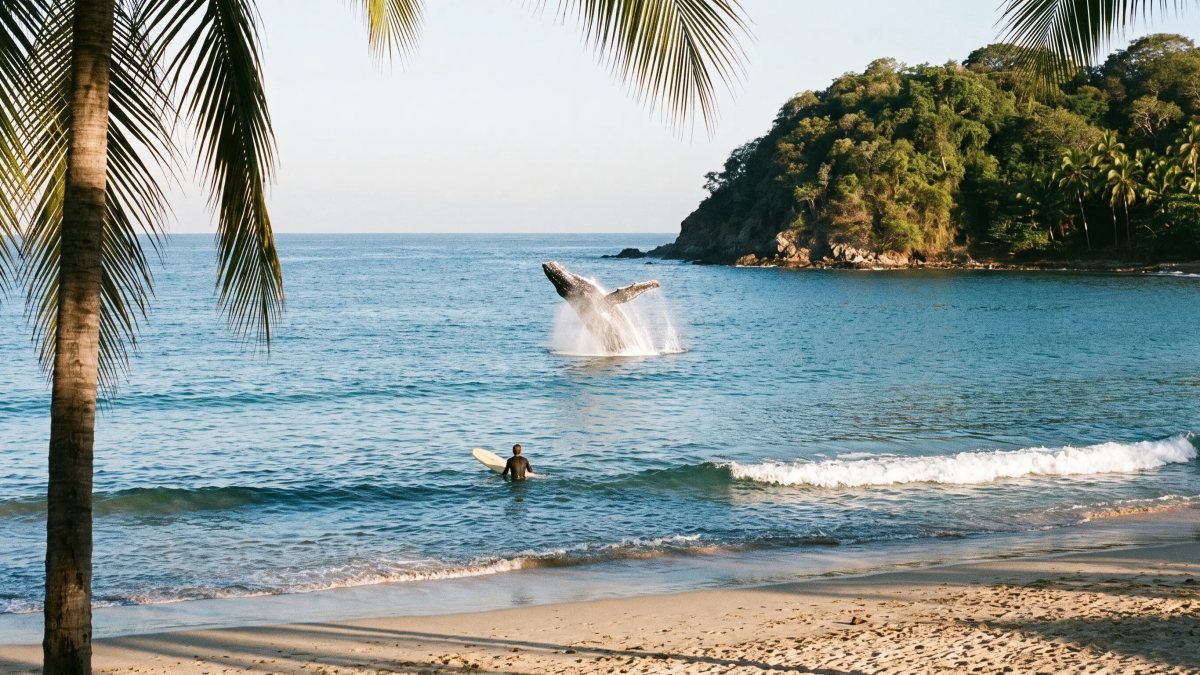
Yes, really. In February, calves are often within a kilometre of the Nuevo Vallarta beach. It is our closest beginner spot to Puerto Vallarta, the waves are mellow, and more than one first-timer has stood up on their first wave with a whale surfacing behind them.
The Sayulita and San Pancho beaches face more north and see fewer whales from the water, though the boat trips out of Sayulita to the Marietas are excellent. If whales are the priority, book a lesson at La Lancha or Punta Mita.
Why winter is the best time to learn to surf here
People assume the summer south swells are "surf season" in Puerto Vallarta. For experienced surfers, they are. For beginners, winter is better, and whale season makes the argument for you:
- Smaller, cleaner waves. The north-west swell wraps into La Lancha and Nuevo Vallarta as long, slow, waist-to-chest-high rollers — the wave you want for your first fifty rides.
- Glassy mornings. The winter land breeze holds the wind offshore until late morning. Lessons at 8:00 or 9:00 get the best conditions of the day.
- Warm water, no wetsuit. The bay stays around 24–26 °C. A rash guard is all you need; we include it.
- The whales. A first surf lesson is already a good story. A first surf lesson with a breach behind the line-up is the one you tell for years.
Our month-by-month guide to when to surf in Puerto Vallarta goes deeper into the swell calendar; the short version for beginners is December to March, mornings, north of the airport.
What you actually see from a surfboard
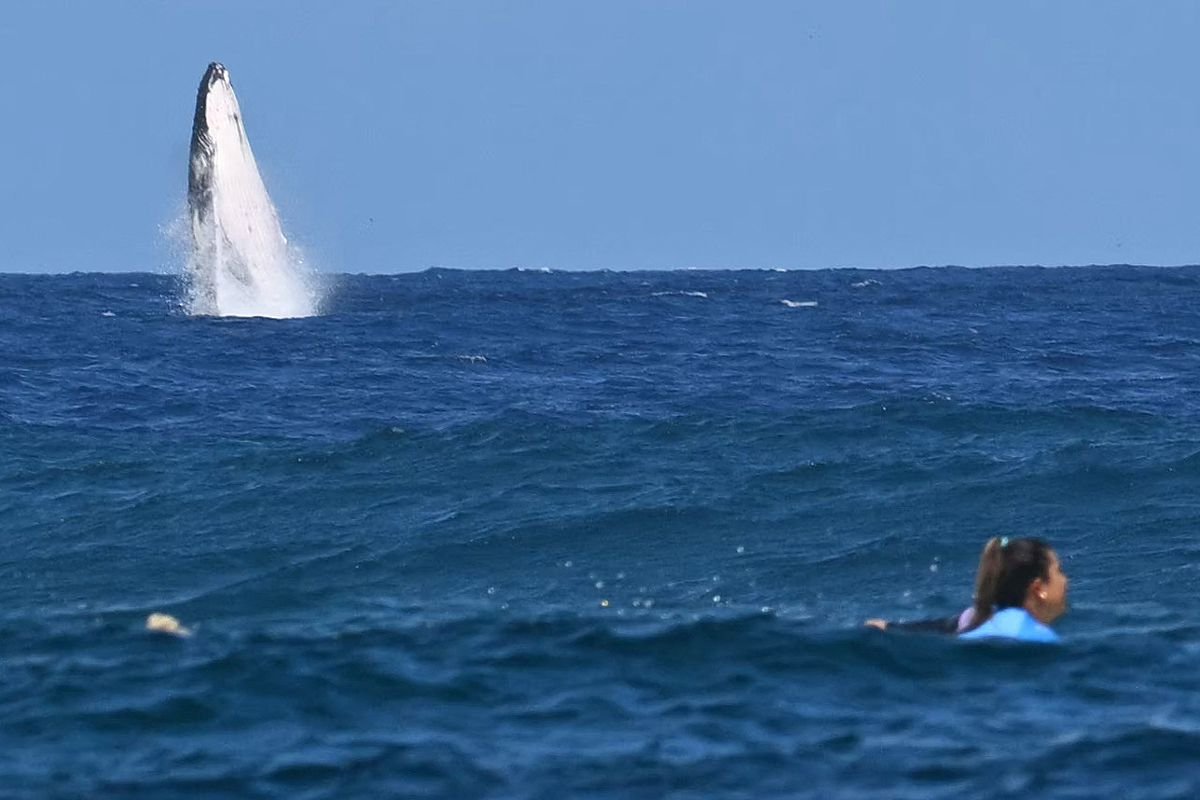
Be realistic: from the water your eyes are a metre above the surface and the whales are usually a kilometre or more out. What you see, in order of how often, is the blow — a tall white puff that hangs for a second — then tail flukes rising before a dive, pec and tail slaps (you hear them before you see them), and, a few times a month, a full breach: the whole animal clearing the water and landing in a burst of white. In January the heat runs pass along the outside — five or six whales travelling fast in a line of spray. Sit up straight, look at the horizon between sets, and you will see more in an hour than most people see from a hotel balcony in a week.
What you will not do is surf with them. Mexican regulations prohibit swimming with whales in Banderas Bay, for their protection and yours, and a surfboard is not a whale-watching platform. If a whale comes inside the line-up — it happens — the right move is to sit still, keep your distance and enjoy the best minute of your trip.
Surf in the morning, whales in the afternoon: the charter option
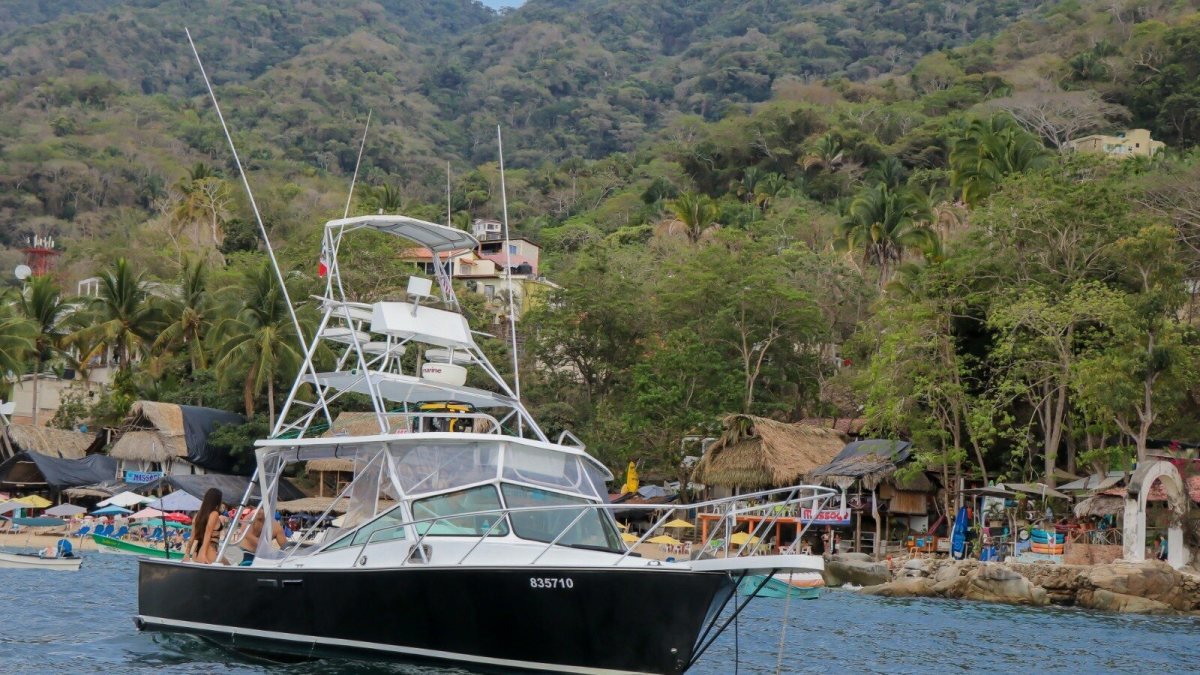
The way to see whales properly — close, at eye level, with the engines off and the sound of a 15-metre animal breathing next to you — is from a boat, and the boat we send our students to is two minutes from our store. Ol' Salty's Ranch runs private whale watching charters in Nuevo Vallarta and Puerto Vallarta out of Marina Nuevo Vallarta: three boats, rented by the hour for your group only, with the whales folded into a fishing trip, a beach day or a sunset cruise instead of a crowded fixed-route tour.
Our favourite winter day for students: a 9:00 a.m. lesson at Nuevo Vallarta, fish tacos, then a four-hour afternoon on the Guanatuna (15 guests, shade and a bathroom, $3,200 MXN per hour with five hours for the price of four) running the south shore for whales and a swim at Los Arcos. Smaller groups who want speed take the Peaceful Easy Feeling panga; big groups take the 53-foot Steel n Time, whose flybridge is the best whale-spotting perch in the marina. Their captains work inside the NOM-131 rules — side approach, idle at the legal distance, never between a mother and calf — which is the only kind of operator we will recommend. Their own whale season 2026–2027 guide has the month-by-month detail from the captain's side.
One warning from experience: the Christmas–New Year weeks, Valentine's week and the February–March spring-break weeks sell out on both sides of the street — our lessons and their boats. Book both in October or November.
Why Banderas Bay: how the whales use it
Humpbacks do not come here to eat — there is almost nothing on the menu in warm water — they come to give birth, nurse and mate. A calf is born at about four metres and a tonne, with almost no blubber, and needs warm, calm, shallow-ish water to put on weight fast before the long swim north in spring. Banderas Bay delivers that in three ways: it is deep in the middle (over 1,000 m off the mouth), which the adults like; it has long stretches of calm, protected water along the south shore and inside the northern arc from Nuevo Vallarta to Punta de Mita, which the mothers like; and the two headlands break the open-ocean swell, which is also exactly why our beginner surf beaches work in winter. The same geography that makes La Lancha a long, gentle roller makes it a whale nursery. Researchers have been photo-identifying individual whales here for decades, and the bay is one of the best-studied humpback wintering grounds in the eastern Pacific — many of the same animals come back year after year, which is one more reason the rules about distance and boats matter.
A whale-season week with Vallarta Surf
If you have five or six days in January or February and want to make the most of both seasons, this is the week we would build for you:
- Day 1 — Nuevo Vallarta, morning: your first surf lesson in Nuevo Vallarta: easy access, mellow waves, whales possible in front of the hotels. Afternoon off; watch the sunset from Bucerías.
- Day 2 — La Lancha: the five-hour private day at La Lancha, transport included. Long rollers, whale blows on the horizon, fish tacos in Punta de Mita after.
- Day 3 — boat day: a four- or five-hour private charter with Ol' Salty's Ranch from Marina Nuevo Vallarta: whales up close, then Los Arcos and a beach. Rest your paddling shoulders.
- Day 4 — Punta Mita or Burros: if you are standing and trimming, an Ultimate Surf Trip to El Anclote or Burros with the whales passing the point.
- Day 5 — Sayulita: the private surf day in Sayulita for the town, the waves and the after-surf scene.
- Flat day, any day: paddle boarding at Los Arcos — in February the calves have been seen from the boards there too.
We keep the exact beach flexible until the morning: the swell and the whale reports decide, not the itinerary.
Whale-season packing list for surfers
- A light windbreaker for the 8:00 a.m. drive north — winter mornings are 18–20 °C, warmer by 10.
- Polarised sunglasses for the beach and the boat: they make blows and flukes pop against the glare.
- Reef-safe sunscreen — the bay is a whale nursery and a marine park.
- A small dry bag if you are doing the boat in the afternoon.
- Nothing else for the surf: board, leash and rash guard are included in every Vallarta Surf lesson.
Frequently asked questions
When does whale season 2026–2027 start in Puerto Vallarta?
The first humpbacks reach Banderas Bay in late November 2026. The official whale-watching season normally opens in the second week of December and closes in the third week of March 2027; peak numbers are in January and February.
Can you see whales while surfing?
Yes. From December to March you will see blows, flukes and the occasional breach from the line-up at La Lancha, Punta Mita, Punta Burros and Nuevo Vallarta — several times a week in January and February.
Is winter a good time to learn to surf in Puerto Vallarta?
The best. Smaller, cleaner north-west swells, glassy mornings, warm water with no wetsuit, and whale season running at the same time.
How do I combine a surf lesson with whale watching?
Morning lesson with us, afternoon charter with Ol' Salty's Ranch from Marina Nuevo Vallarta, two minutes from our store. Message us on WhatsApp and we will line up both.
Which surf spot is best for whales?
La Lancha, then the Punta Mita breaks — both face the entrance of the bay. Nuevo Vallarta surprises people in February when the calves come close to shore.
Can I swim or surf with the whales?
No. It is prohibited in Banderas Bay, and any operator offering it should be avoided. Watch from the board; from a boat, keep the legal distance and let the whale decide.